Fitness & Movement›Foot Health›Regular Shoes vs. Barefoot Shoes
Foot health · Regular vs. barefoot shoes · 5 barefoot brands tried
Regular Shoes vs. Barefoot Shoes: Which Is Better for Your Feet Every Day?
Sore feet by evening, stiff toes in the morning, shoes that used to fit and now pinch. I looked at what everyday shoes do to your feet over the years, what changes when you switch to barefoot shoes, and which barefoot shoe I'd actually buy.
By Melissa J. · Updated Oct 2026 · 7 min read
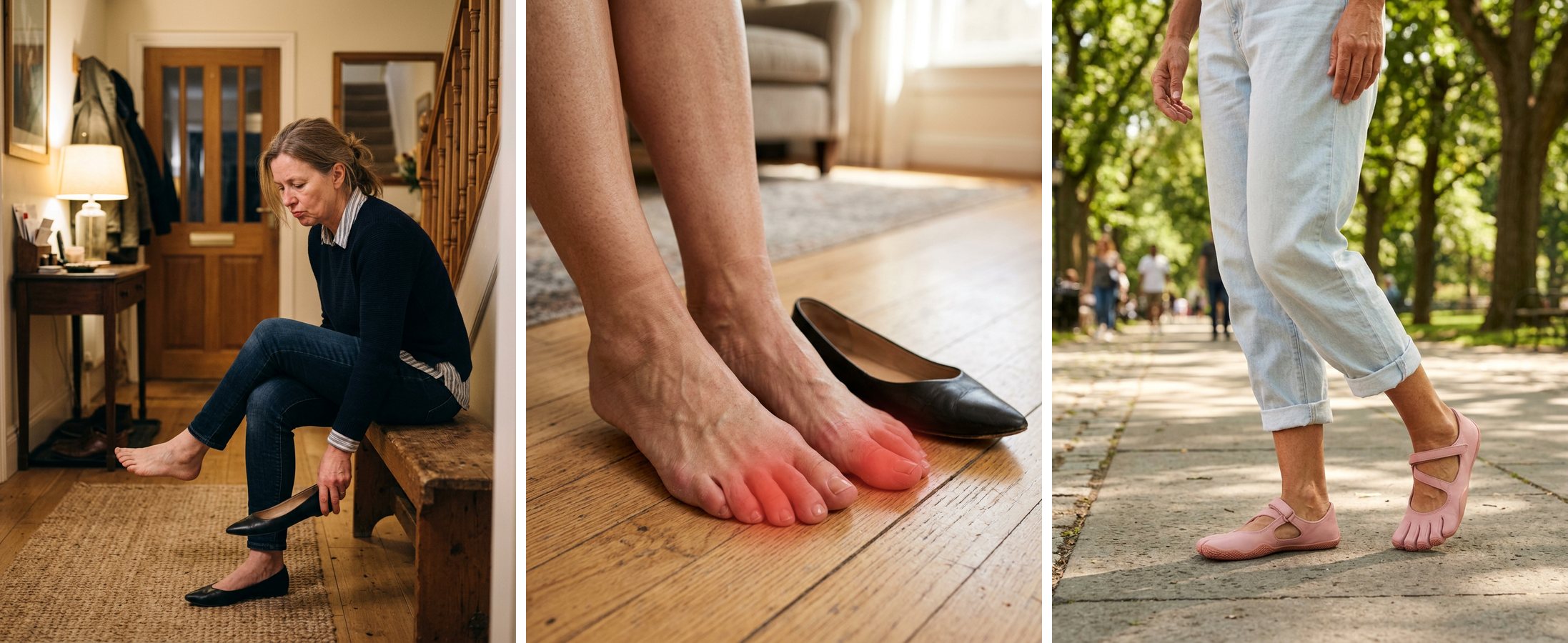
Tight shoes all day, sore feet all evening. Does it have to be that way?
You come home, kick off your shoes, and the first thing you feel is relief. Then the aching starts: the ball of your foot, the side of your big toe, your heels. In the morning your toes feel stiff before you've taken a single step. Most of us think that's just what feet are like as we get older.
But here's something few people stop to think about: we spend 10 to 14 hours a day in shoes, and almost none of them are shaped like a foot. Look at the front of your favorite pair. It's narrower than your toes. The heel is raised. The sole is thick and stiff. Over the years, your feet slowly adapt to that shape, and not in a good way.
So I asked myself a simple question: what actually happens to your feet in regular shoes, and what changes in barefoot shoes? Then I tried five of the best-known barefoot shoes to find the one worth buying.
What your everyday shoes are really doing to your feet
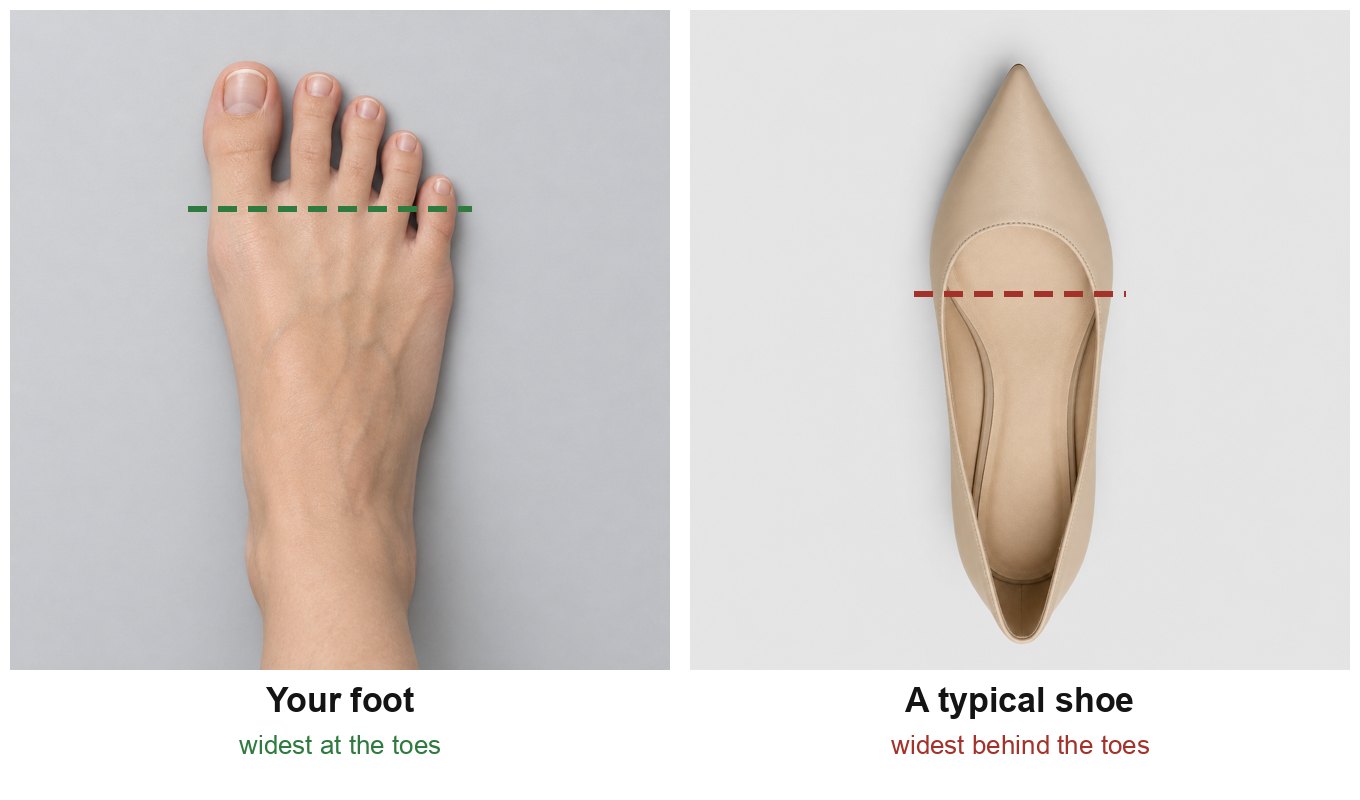
A healthy foot is widest at the toes. When you stand barefoot, your toes spread out a little, grip the floor and help you balance. Now look at almost any regular shoe, from sneakers to work flats to "comfort" shoes. Each one does at least one of these four things:
A narrow, pointed toe box that presses your toes together, day after day.
A raised heel (even sneakers usually have one) that tips your weight forward onto the ball of your foot.
A thick, stiff sole that stops your foot from bending and feeling the ground.
Built-in arch support and cushioning that does the work your foot muscles should be doing.
None of this hurts on day one. That's the problem. It feels comfortable in the store, and the damage builds slowly, over years.
What happens after years in regular shoes
Muscles you don't use get weaker. Your feet are no different. When a shoe holds your arch, cushions every step and keeps your toes squeezed together, the small muscles inside your foot have less and less to do. Many people notice it first as stiffness, then as tired, achy arches at the end of the day.
Squeezed toes cause a second problem. The big toe gets pushed toward the others, the joint at its base starts to stick out, and over time a bunion can form. Genes and age play a part too, but a narrow toe box makes things worse, and it's the one factor you can change.
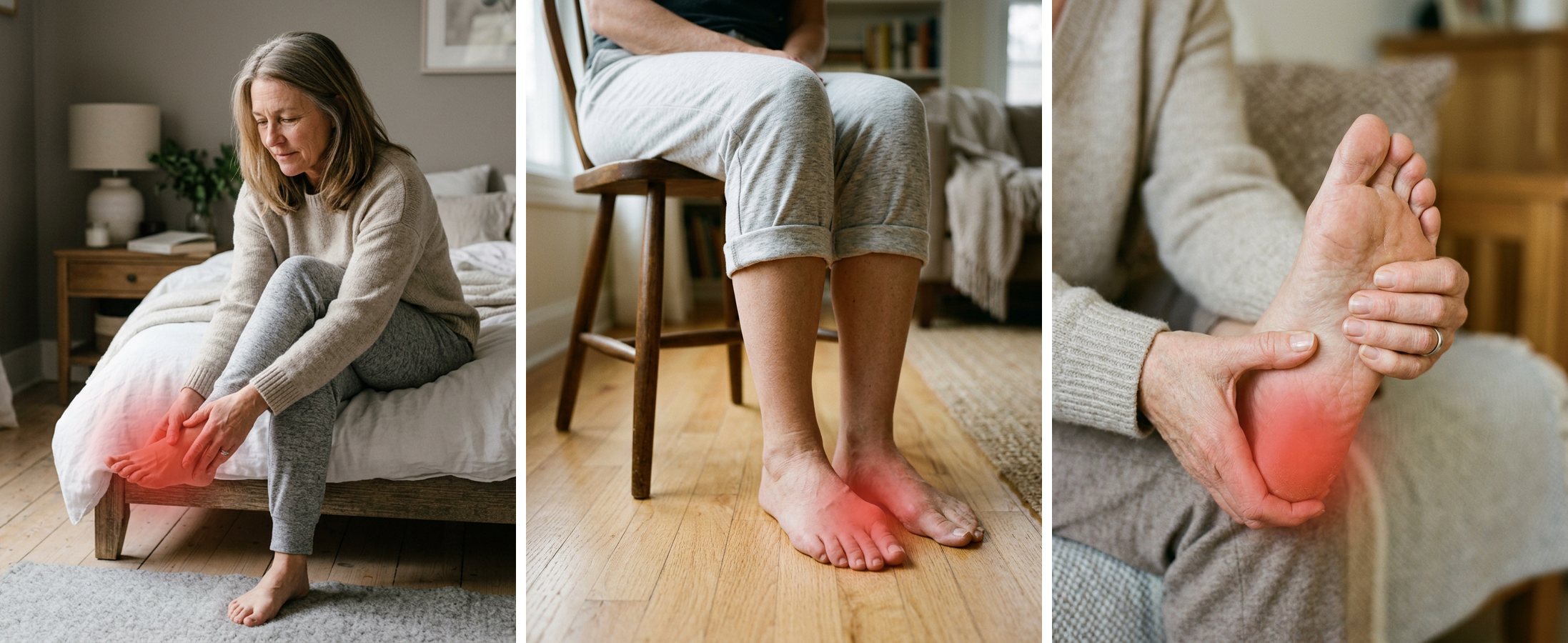
Stiff toes, a growing bunion, sore heels: problems that build slowly, step by step.
It's far more common than most people think, especially in women:
Source: Nix, Smith & Vicenzino, Journal of Foot and Ankle Research, 2010 (systematic review and meta-analysis).
And the fit makes it worse: research reviews have found that between 63% and 72% of people wear shoes that don't fit their feet properly, most often too narrow.
Source: Buldt & Menz, Journal of Foot and Ankle Research, 2018 (systematic review).
Regular shoes vs. barefoot shoes, side by side
Barefoot shoes are built the other way round: the shoe follows the shape of your foot, instead of your foot following the shape of the shoe. Here's how the two compare:
Regular shoes
Barefoot shoes
Toe room
Narrow, toes pressed together
Wide, toes can spread
Heel
Raised, weight tips forward
Flat ("zero drop")
Sole
Thick and stiff
Thin and flexible
Feeling the ground
Blocked by foam
You feel the floor
Foot muscles
Shoe does the work
Your feet do the work
Balance
Less feedback from the floor
More stable, more natural
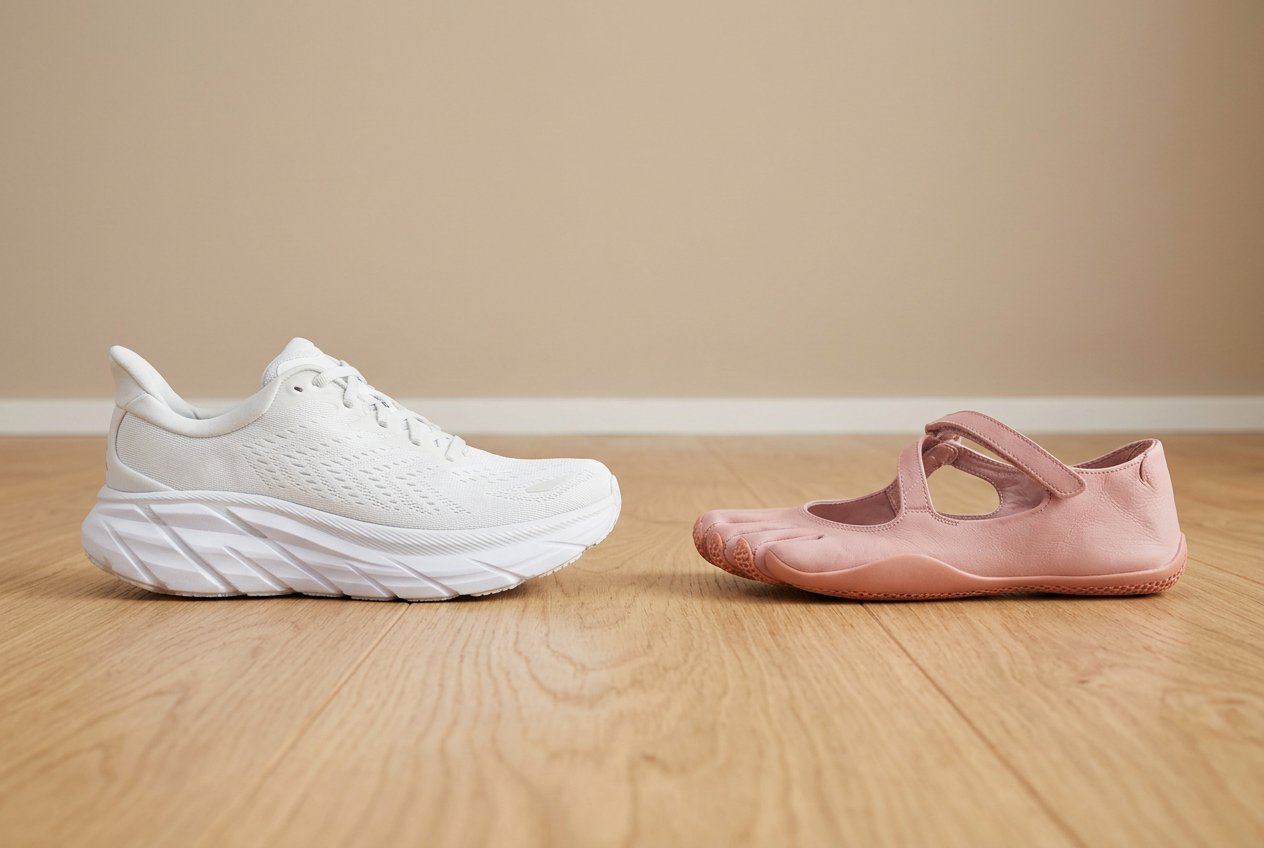
Left: a typical cushioned sneaker with a thick, raised sole. Right: a toe shoe with a thin, flat sole and a pocket for every toe.
What changes when you switch
When your shoes stop doing all the work, your feet start working again. In a 2019 study, adults who walked in minimalist shoes for six months increased their foot strength by more than half, about the same as people who did foot exercises every day.
Source: Ridge et al., Medicine & Science in Sports & Exercise, 2019.
Many people who switch say they notice it in everyday moments:
Toes that spread and grip again, on the sidewalk, at home and at the gym.
Steadier balance, on stairs, curbs and uneven sidewalks.
Feet that feel less tired at the end of the day, once they're used to it.
Less of that stiff, "stuck" feeling in the morning.
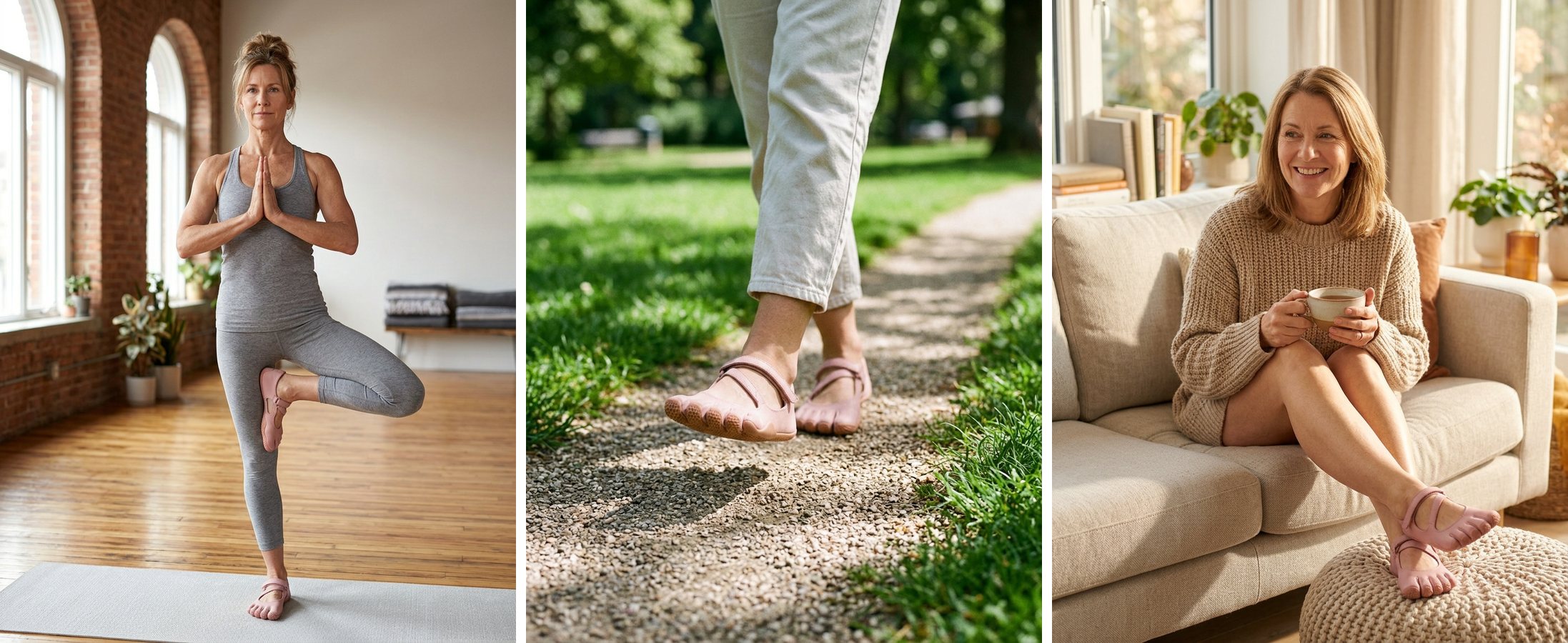
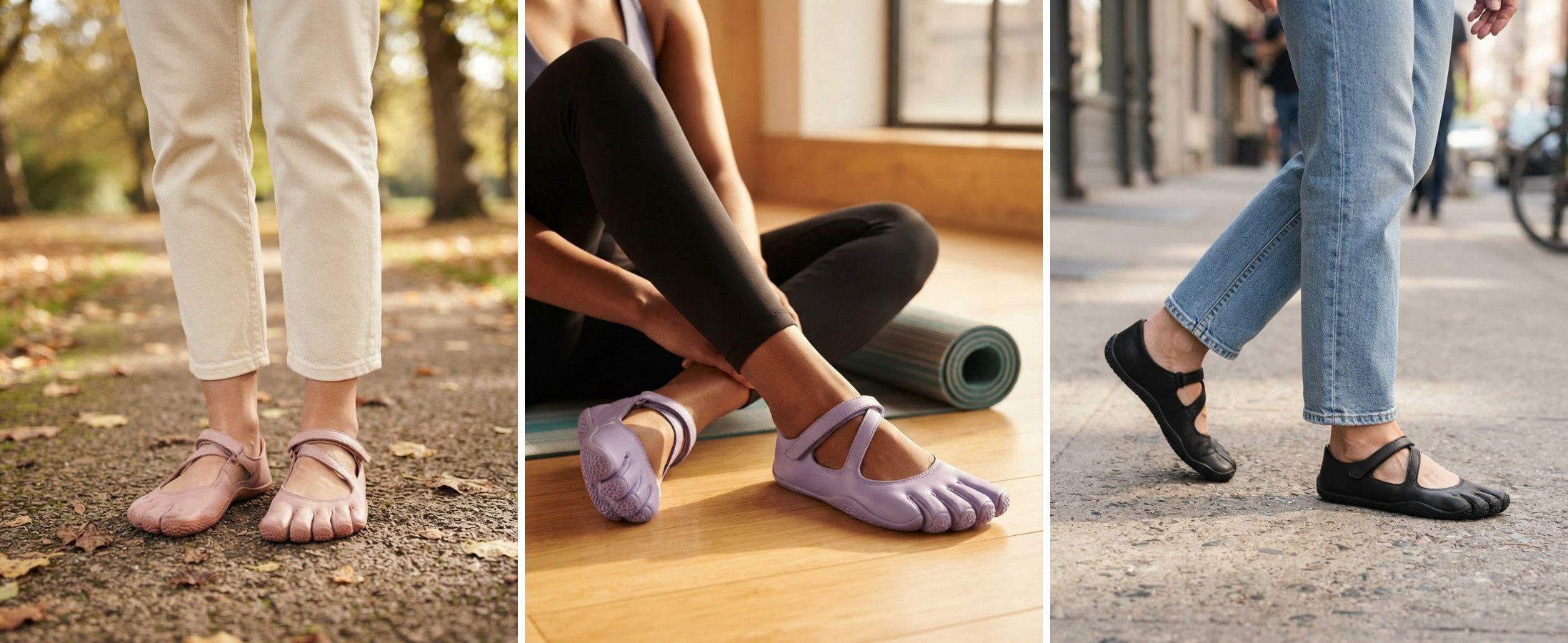
On the mat, on a walk, at home: feet that can spread, grip and balance.
Go slowly: how to switch
Your feet have spent years in regular shoes, so give them time. Start with an hour or two a day and build up over a few weeks. Sore calves in the first days are normal; that's muscles waking up. If you have diabetes, nerve problems or a foot condition, ask your doctor before switching.
Why insoles, pads and "comfort" shoes don't fix it
When feet hurt, most of us reach for more padding. Gel insoles feel nice, but they add even more cushioning between you and the ground. Bunion pads and toe spacers help at home, but you can't fit them in a narrow shoe. "Comfort" and "wide" shoes give a little more room, but still have a thick sole and a raised heel.
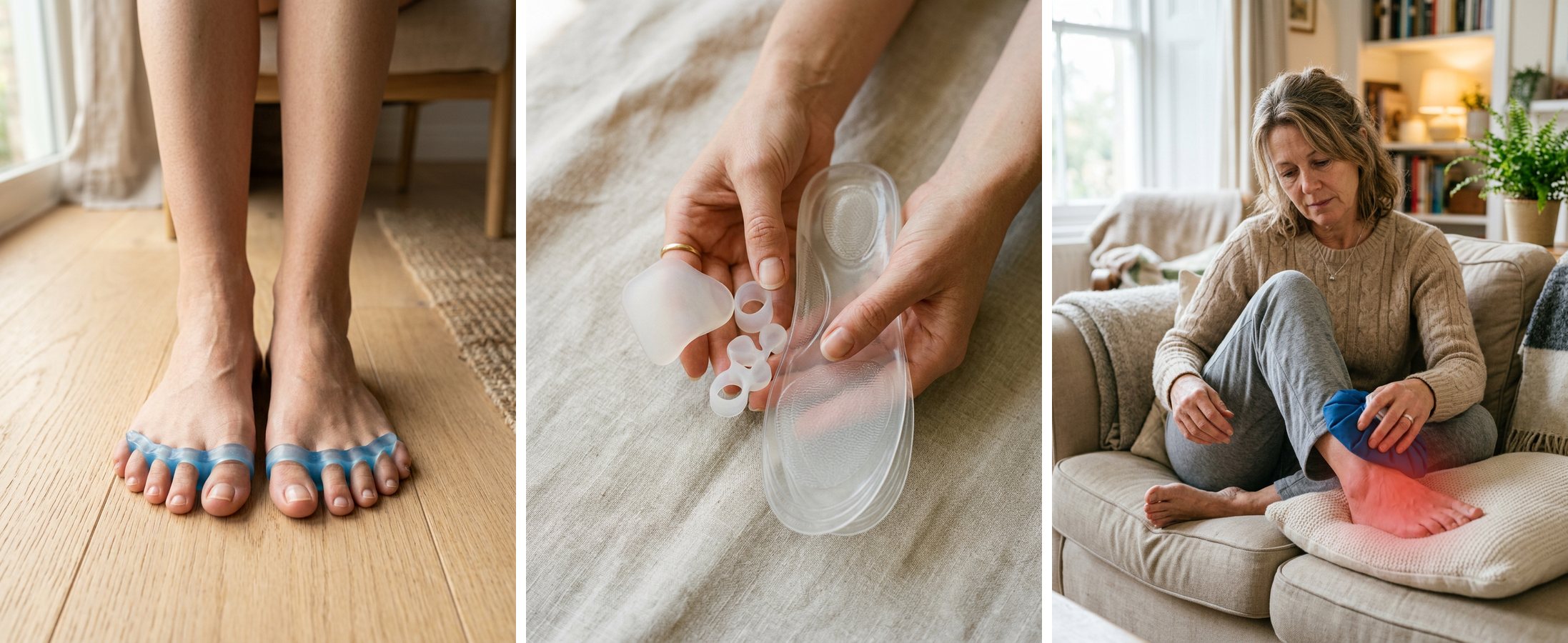
Toe spacers, insoles, ice packs: each helps a little, but none changes the shape of the shoe.
They treat the symptoms. The shoe is still the wrong shape. That's why so many people end up with a drawer full of pads and insoles, and the same sore feet.
But not every barefoot shoe is the same
Once you decide to try barefoot shoes, it gets confusing. The word "barefoot" isn't protected, so any brand can print it on the box. And most "barefoot shoes" still put all five toes in one shared space. They're wider than a regular sneaker, but your toes still can't move on their own.
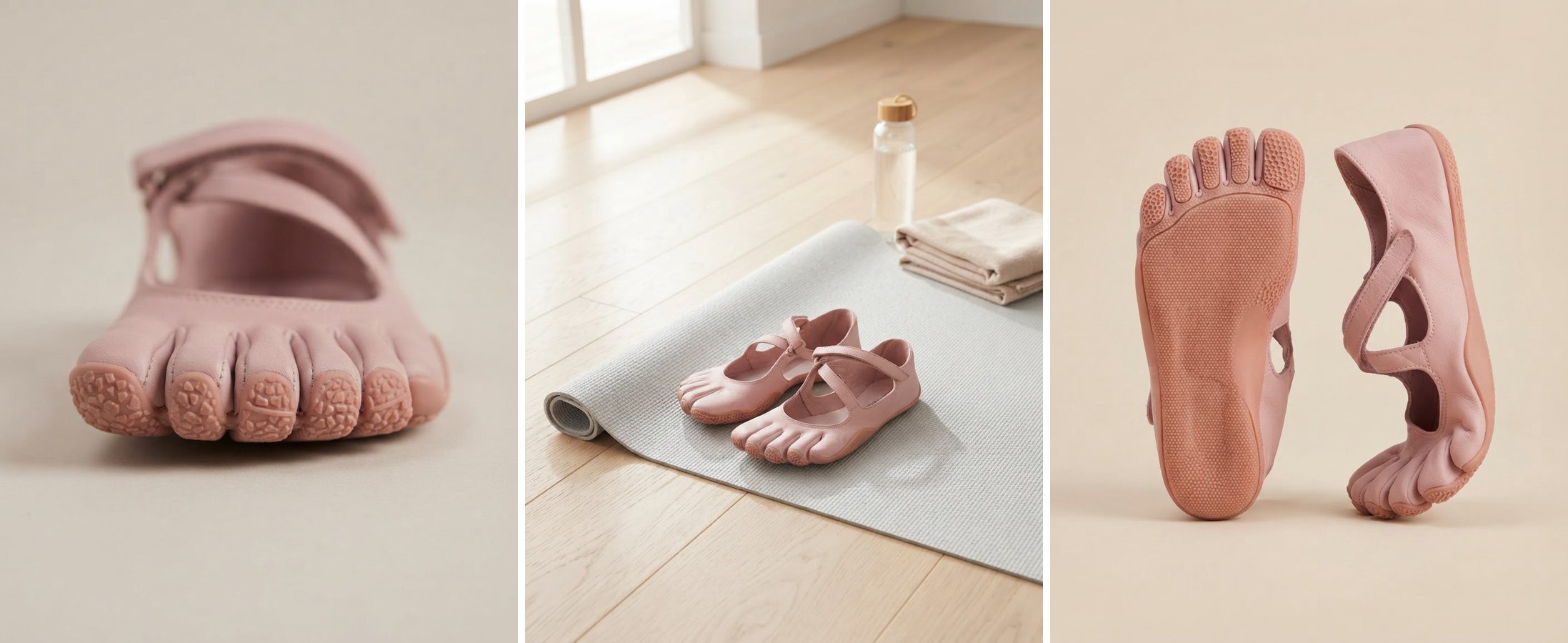
That's where toe shoes are different: every toe has its own pocket, so your toes spread, grip and balance just like barefoot, with a thin, flat, non-slip sole underneath.
To find out which one is actually worth buying, I tried five of the best-known barefoot shoes in the U.S., on long walks, everyday errands, at home and at the gym, and rated them on toe freedom, ground feel, grip, everyday comfort and value. Read my full test here, or see the short version below.
Real toe pockets, flat grippy sole and a strap that holds, for less than the big names
SCORE9.5
2
Vibram FiveFingers KSO EVO
The original toe shoe and well made, but it costs more [CONFIRM con]
SCORE8.4
3
Vivobarefoot Primus Lite
Great thin sole and a wide front, but the toes still share one space, and it's the priciest
SCORE7.8
4
Xero Shoes Prio
A solid everyday barefoot sneaker, but no toe pockets, and some find it narrow
SCORE7.3
5
Saguaro Vitality III
Very affordable, but no toe pockets, and the build feels budget [CONFIRM con]
SCORE6.6
My #1 pick: BarefootGo Five-Toe Shoes
Best overall · Rank 1
BarefootGo Five-Toe Shoes
SCORE9.5
Of everything I tried, this is the one built for how a foot really moves: toes spread, heel low, sole bending with every step. Each toe sits in its own pocket, the rubber sole is flat and zero-drop, and the strap across the middle holds the shoe in place without pressing on the toes. Every other shoe in my test got at least one of these wrong.
My first real test was a completely normal day: errands, a long walk, standing in the kitchen. Every toe pressed into the ground on its own, and I felt steadier on stairs and curbs. Same at the gym and in my yoga class. [CONFIRM: real team experience]
What convinced me most: after the first few days, I stopped thinking about my feet at all. No cramped toes at the end of the day, no changing shoes between the studio and errands. And at $89.90 (list price $115), they cost less than the best-known toe shoe in my test.
Flat, zero-drop rubber sole that bends with your foot
Non-slip outsole for mats, gym floors, tracks and light trails
Adjustable strap: quick on and off, secure hold
$89.90, less than the original toe-shoe brand
30-day money-back guarantee · 5 colors
CONS
Only available online, directly from BarefootGo
Women's sizes US 6–10.5 only
Toe shoes take a few tries to slip on
Made for light to moderate running, not rough trails
Best for
Anyone who spends a lot of time on their feet, from errands and long walks to the gym and yoga, and wants their toes to move freely, without paying a premium for the original brand. My clear recommendation.
Sizes and colors sell out from time to time. Check the size chart on the product page before ordering.
The other four, in short
Vibram FiveFingers KSO EVO (8.4): the original toe shoe and well made, but it costs more than my #1 pick. Vivobarefoot Primus Lite (7.8): a great thin sole and a wide front, but all five toes share one space, and it's the priciest. Xero Shoes Prio (7.3): a solid everyday barefoot sneaker, but no toe pockets. Saguaro Vitality III (6.6): very affordable, but no toe pockets and a budget feel.
Regular shoes are shaped for looks, not for feet. Over the years, narrow toe boxes, raised heels and thick soles leave many of us with weaker feet, stiff toes and bunions that keep growing. Pads and insoles only treat the symptoms.
Barefoot shoes let your feet do what they were built to do. And if you want your toes to move freely, a toe shoe with a pocket for every toe goes one step further than a wide barefoot sneaker. The problem was never your feet. It was what you put them in.
My verdict after weeks of wearing them
BarefootGo wins with a score of 9.5/10, for four reasons:
Real toe freedom. A separate pocket for every toe, so your toes spread and grip like they do barefoot.
A sole that works with you. Flat, zero-drop and flexible, with a non-slip outsole that held on mats, gym floors and tracks.
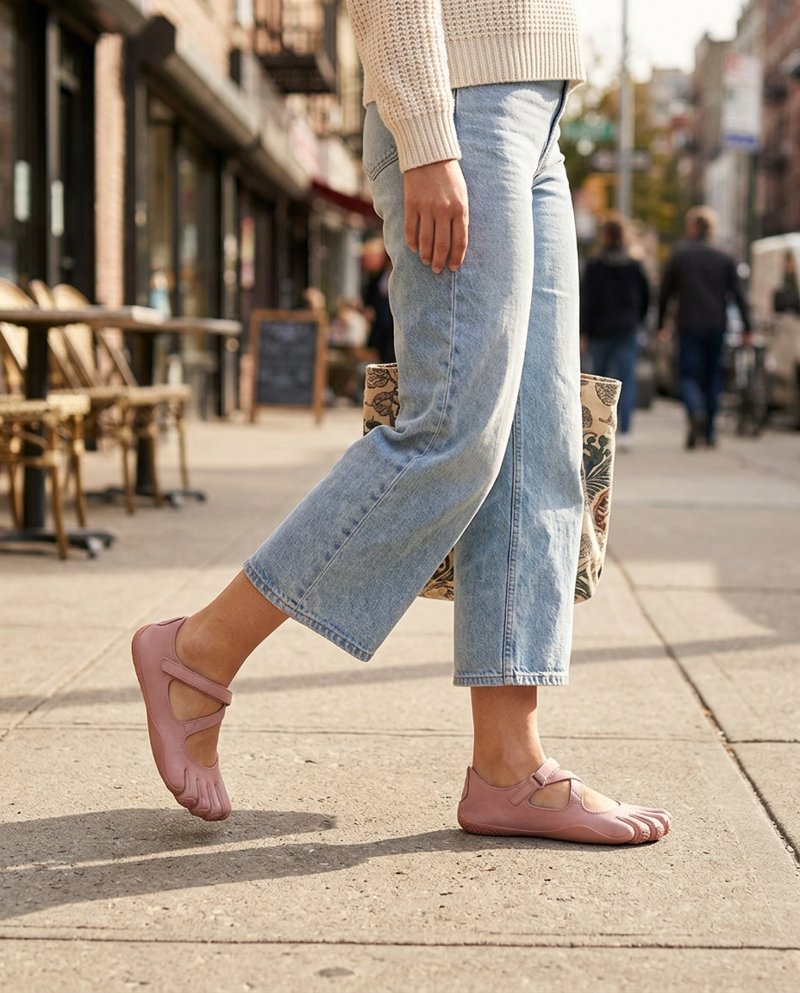
Easy to live with. The adjustable strap makes them quick to put on, and they go from morning walk to errands to a class without a change of shoes.
Fair price, no risk. $89.90, less than the original toe-shoe brand, with a 30-day money-back guarantee and five colors.
Vibram is excellent but costs more. Vivobarefoot and Xero are good barefoot sneakers, but your toes still share one space. Saguaro is a budget way to try barefoot. BarefootGo ticks every box.
My tip: start with an hour or two a day and build up over a couple of weeks. Your feet have spent years in normal shoes. Give them time, and wear them every day, not just on gym days.
Editor's note: TrustCore Reviews and BarefootGo are part of the same brand family. See About us.
Offer for our readers
BarefootGo Five-Toe Shoes: my #1 pick with a score of 9.5/10. Real toe pockets, a flat non-slip sole and an adjustable strap. Now $89.90$115, available directly from BarefootGo in five colors, US women's sizes 6–10.5.
First few times in these and I could feel every toe working separately. The individual pockets let your forefoot spread the way it's designed to. By week two I noticed better balance in poses I'd been struggling with for months. These have changed how every step feels.
14 people found this helpful
J
Julia O.✓ Verified buyer · March 2026
★★★★★Perfect for daily. Ground feedback is amazing
I feel connected to the mat in a way I never did barefoot. The toe separation gives real stability during standing poses and one-leg balances. These are now a permanent part of my practice.
10 people found this helpful
D
Diana N.✓ Verified buyer · Jan 2026
★★★★★From gym to errands. One shoe does everything
I wear them for gym sessions in the morning and keep them on for errands after. The flat sole is solid enough for pavement and light enough that my feet don't feel tired at the end of the day.
12 people found this helpful
M
Mark S.✓ Verified buyer · March 2026
★★★★★Wore them hiking and they held up perfectly
Light trail walking, uneven ground, damp grass. The rubber outsole dealt with all of it. I was surprised by how confident the grip was given how minimal the shoe feels. Will definitely take them on more walks.
9 people found this helpful
A
Angela L.✓ Verified buyer · Feb 2026
★★★★★First pair that actually fits my wide toes
I have always struggled with shoes that pinch the front of my foot. These let my toes sit flat and spread without fighting the sides. The individual pockets are generous and nothing feels forced.
8 people found this helpful
S
Samira H.✓ Verified buyer · Jan 2026
★★★★★Half the price of the famous brands
I expected cheaper quality. What I got was the same experience: individual toe pockets, flat sole, good grip, at a price that lets me own three colourways for less than one pair of the premium option.
7 people found this helpful
C
Christian F.✓ Verified buyer · Jan 2026
★★★★★My feet feel different after just two weeks
I don't know how else to describe it except that my feet feel more awake. The toe separation and flat sole are activating muscles I didn't know were switched off. The stiffness I used to feel in the mornings is noticeably reduced.
3 people found this helpful
R
Rachel T.✓ Verified buyer · June 2025
★★★★★Forgot they were on my feet
Wore these for yoga in the morning and didn't take them off until after my evening walk. The toe pockets feel natural after the first hour and the rubber grips every surface I tried.
A
Amelia B.✓ Verified buyer · June 2024
★★★★★Office-casual style, barefoot comfort
The clean, minimal look works with smart-casual clothes but the individual toe pockets and flat sole feel like a completely different experience to any office shoe I've owned. Long meetings are much more comfortable now.